
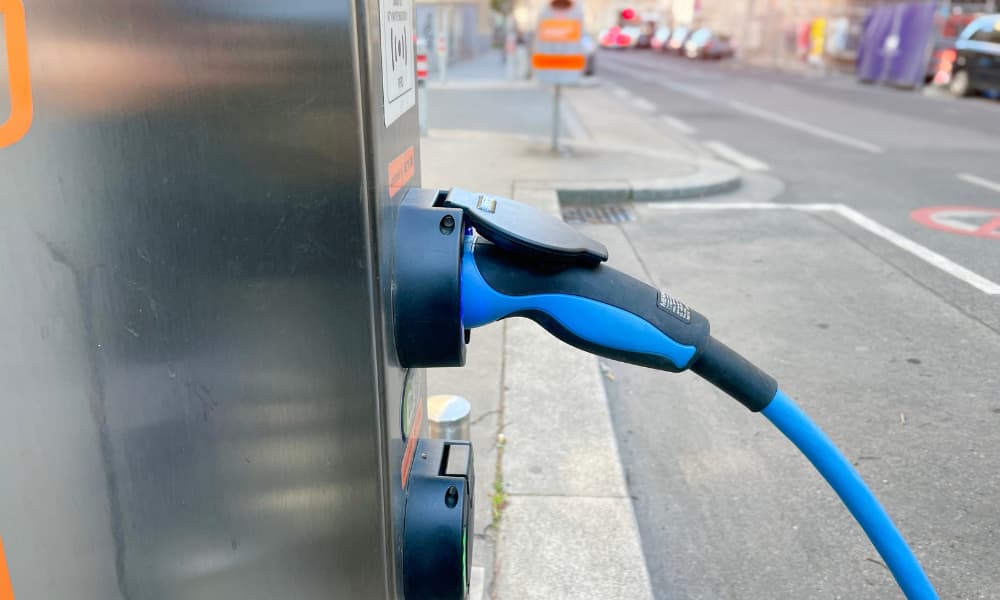
Evolving NY EV policy requires a working knowledge of legal regulations and insurance. Here’s a plain English explanation for boards, shareholders, and tenants.
Key takeaways:
- New York Real Property Law §339-LL provides the basis for EV installations in co-ops and condos.
- Condos and co-ops have similar responsibilities but differing powers.
- Understanding EV charger condo insurance in New York is a critical factor in installation and compliance.
The latest Department of Energy figures reveal that New York State may rank only sixth nationwide in registered EVs, but that still amounts to 131,250 drivers looking for chargers and wondering how to properly insure their EV.
What’s more, Governor Hochul’s focus on expanding EV charging infrastructure by stimulating $4 billion in investment is designed to accommodate a significant increase in EV ownership in the next decade. This poses a big question for condos and co-ops:
“How do we compliantly approve and insure Level 2 (240V outlet) EV chargers in shared buildings?”
Here’s a clear explanation of EV charger condo insurance in New York (and co-op insurance), breaking down what owners, boards, and property managers must know to stay compliant and reduce insurance risk.
NICRIS Helps Navigate EV Charger Insurance
We help clarify EV charger condo insurance requirements in New York for both owners and associations by reviewing master policies and personal plans to identify coverage gaps and advise on setting appropriate liability limits.
We help unit owners secure the necessary insurance documentation for board approval and support boards and property managers in establishing consistent, reliable insurance standards.
Contact us today for a confident head start on New York’s EV evolution!
Why EV Charging Is a Building-Level Issue in NY
In addition to Governor Hochul’s strong EV focus and the rising number of EVs being registered, the state’s Advanced Clean Car II regulation, adopted in December 2022, is gaining momentum toward requiring all light-duty passenger cars, pickup trucks, and SUVs to be zero-emission by 2035.
This will increase demand for at-home charging in NYC and surrounding areas. It will also make Level 2 EV chargers a key amenity for condos and co-ops, requiring crystal clear definitions of who owns the chargers, who’s responsible for their installation and maintenance, and how they’ll be insured.
Aren’t Condo and Co-op Rules the Same?
No, and the structural and stakeholder differences play important roles in answering the questions above. The key distinctions between the two models are:
- With co-ops, residents are shareholders and own the building.
- In condos, unit owners own their space with boards governing common elements.
Despite the differences in the two residential models, they’ll both be making decisions based on New York Real Property Law §339-LL, so let’s explore that.
What §339-LL Says About EV Charger Condo Insurance in New York
This law creates an operational framework while leaving room for building-specific policies. For example, it states that condo boards must allow EV chargers under right-to-charge laws while meeting certain responsibilities.
Condos may impose reasonable restrictions that don’t significantly decrease charger performance or significantly increase the station’s cost.
Here’s how that usually works:
- Boards must comply with local building codes and permits.
- They must impose risk restrictions by requiring EV chargers to meet safety and electrical standards.
- They have a say in the selection of licensed contractors. Regarding EV charger condo insurance in New York, all contractors must be licensed and insured.
- Boards can make decisions based on aesthetic or structural considerations that are affected by EV charger installations.
- They can designate EV chargers to be installed only in approved areas.
- They may request an electrical capacity study.
Boards can also require indemnification agreements to protect the building against damage incurred during EV charger installation.
Unit owners are typically required to:
- Pay for EV charger installation and maintenance.
- Carry their own liability insurance.
- Provide a certificate of insurance within 14 days of approval, which also names the association as an additional insured under the owner’s insurance policy under Article C.
This doesn’t mean that only tenants and boards are responsible for insurance for EV charger installations. Here’s exactly who insures what.
Breaking Down EV Charger Condo Insurance in New York
Unit owners/shareholders must insure themselves against liabilities related to the installation and use of EV chargers, particularly if the charger is considered personal property.
Liabilities might include electrical fires, damage to shared infrastructure, or injuries caused by equipment malfunction or improper use.
The building’s master policy covers the structure, its shared spaces and common areas, and electrical systems within those boundaries. Some master policies also cover electrical systems inside living units.
The contractor installing the EV chargers must be insured against certain risks. These include improper installation, which may result in short circuits, fires, or insufficient sealing, allowing water to enter the charger.
Code violations are another concern that can result in the building owner being fined. Therefore, it’s extremely important that condos and co-ops work with knowledgeable, reputable contractors who prioritize EV charger condo insurance in New York.
How Do Co-ops Handle EV Charger Approvals Differently?
Co-ops have more powers to approve or deny installations under §339-LL’s legal framework. This is due to the power held by the building’s shareholders, who own all units, making board alignment more influential on the outcome.
However, approving charger installation does share focus with condos on certain elements:
- Who owns the equipment?
- Who’s responsible for repairs and maintenance?
- Unit owner and contractor insurance align with the building’s master policy.
- Requesting an electrical capacity study.
In both situations, boards won’t approve modifications without the right documentation, so they will usually require:
- Proof of contractor insurance.
- A certificate of insurance (COI) from each unit owner.
- Minimum liability limits.
- An agreement to maintain coverage for the life of the charger.
- Proof of additional insured status for the association or building.
These are key elements in starting EV charging projects strongly. It’s then time for boards, corporations, and tenants to check off their final pre-installation responsibilities.
Best Practices for Smooth EV Charger Approval
Approvals and EV charger condo insurance in New York happen faster when everyone knows their part from start to finish. For boards and corporations, that means:
- Starting with an installation proposal that comprehensively breaks down every part of the process and shares it with all stakeholders.
- Hiring licensed and insured EV installation contractors familiar with local and city codes.
- Fixing an indemnity agreement.
- Clearly communicating unit owners’ responsibilities to shareholders and tenants.
Unit owners should observe the following best practices:
- Proactively asking property managers or board members for clarity on expectations.
- Confirming their liability coverage meets board requirements.
- Documenting all agreements, approvals, and coverage information.
Boards, corporations, and tenants can all benefit from speaking to an experienced NY insurance advisor. This strengthens proposals and policies by recognizing coverage risks as soon as possible.